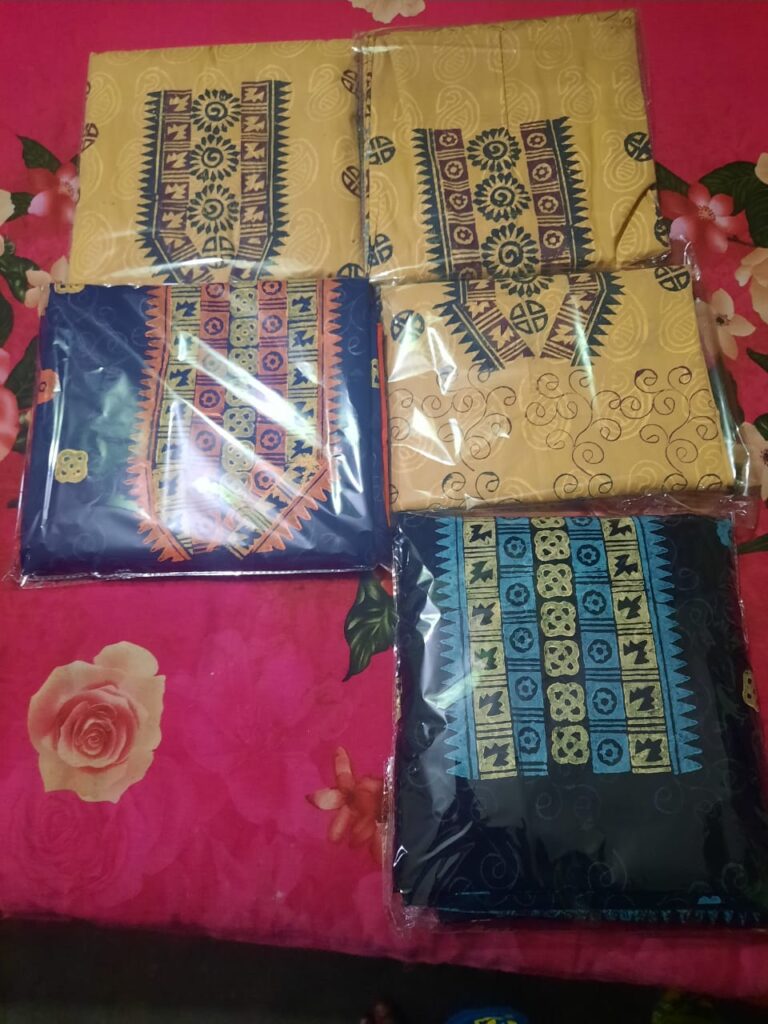
Block print is one of the best types of printing because it requires handmade work and involves creating various unique designs. I have known about this for a long time, but when I felt interested in working on it, I started researching it deeply. Through my research, I learned many new things. I started this work from the beginning of 2025 and began to understand what materials and skills are needed for block printing.
Main Discussion
To do block printing, it is very important to choose the right quality fabric. When I went to the market, I learned about a fabric called poplin, which is very suitable for this work. Before that, I only knew about two types of plain fabric: voile and poplin cotton.
Later, I faced another problem—colors do not show well on all fabrics. I discussed this with an experienced person (an “apu”) who had worked with block printing before. She advised me to use light-colored fabrics because darker colors appear better on them. For example: light pink, pastel shades, and other soft colors.
Color Mixing
For block printing, the colors are not usually ready-made. At first, I thought ready colors were available, but when I went to the shop, the shopkeeper told me that ready colors are not very long-lasting. Instead, I needed to buy different chemicals to prepare colors.
I did not know how to mix them properly, so I searched online and found a page offering a package of necessary materials. I ordered it, and it was delivered to my home. However, I still faced difficulty understanding how to create specific colors using those chemicals.
Even though it was challenging, I kept trying because I always had a passion for learning something new since childhood.
Color Process
To prepare colors, several chemicals are required, such as:
Ink
Apron (Binder)
CCL
Newtex
Oxal
At the beginning, I did not understand the correct measurements. Sometimes I used too much or too little, which affected the results. But after practicing many times, I finally learned the right proportions.
Design Making
Choosing the right design is also very important. At first, I could not create complex designs, so I started with simple ones. I worked on a few sarees, panjabis, and two-piece and three-piece dresses. My first designs were not very perfect, but I continued practicing and improving.
Fabric & Color Combination
Another important part is choosing the right color combination for fabrics. For example:
Sarees and panjabis mainly require good color matching.
For three-piece dresses, you need to combine three parts: orna, kameez, and pajama.
You cannot use the same color for all three pieces. For instance, if the orna and kameez are white, the pajama should be in a different color to create a balanced look.
To learn this, I observe different designs whenever I go outside. One day at a Boishakhi fair, I saw many people selling hand print and block print items. Although I could not buy them, I carefully touched the fabrics and observed the quality and color combinations.
I realized that not all colors go well together—choosing the right combination is very important.